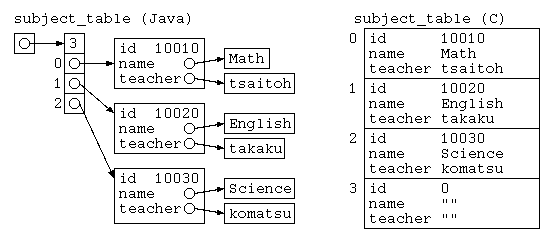
情報構造論では、この後には、複雑なデータ構造を扱うために、Javaによるオブジェクト(あるいはC言語による構造体データ)を多用する。そこで、基本的なJavaのオブジェクトと、C言語の構造体についておさらいとする。
Javaでオブジェクト指向
オブジェクトを扱うプログラムの基本プログラムを示す。例えば、名前と年齢のデータをクラスで扱うのであれば、以下のようなコードが基本となるだろう。
import java.util.*;

class NameAge {
    String name ;          // インスタンス変数
    int    age ;           // インスタンス変数
    static int count = 0 ; // クラス変数
    // コンストラクタ
    NameAge( String s , int a ) {
        this.name = s ;
        this.age  = a ;
        count++ ;
    }
    // メソッド
    void print() {
        System.out.println( this.name + "," + this.age ) ;
        System.out.println( "member = " + count ) ;
    }
} ;

public class Main {
    public static void main(String[] args) throws Exception {
        NameAge tsaitoh = new NameAge( "tsaitoh" , 59 ) ;
        tsaitoh.print() ;
        System.out.println( "age = " + tsaitoh.age ) ;
        NameAge tomoko  = new NameAge( "tomoko" ,  48 ) ;
        tomoko.print() ;
    }
}

実行結果
tsaitoh,59
member = 1
age = 59
tomoko,48
member = 2
- オブジェクト指向の基礎(Paiza.io)
クラスとは、データ構造(オブジェクト)とそのデータ構造を扱うための関数(メソッド)をまとめて扱う。
クラス NameAge の中で宣言されている、NameAge() の関数は、オブジェクトを初期化するための関数(メソッド)であり、特にコンストラクタと呼ばれる。
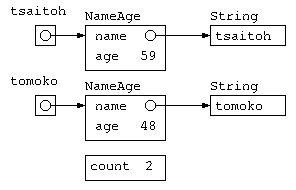
実際にデータを保存するための tsaitoh や tomoko とよばれる変数に NameAge オブジェクトの実体(インスタンス)を作る時には 「new クラス名」 とやることで、初期化ができる。
イメージでは、下図のようなデータ構造ができあがる。
でも、年齢の覚え方は、将来的に誕生日を覚えるように変化するかもしれない。この際に、Main 関数の中で age を使うと後で混乱の元になるかもしれない。こういう時は、NameAge クラス以外では中身を勝手に使わせないために、インスタンス変数などに public / private といったアクセス制限を加える。
import java.util.*;
class NameAge {
    private String name ;          // インスタンス変数
    private int    age ;           // インスタンス変数
    public  static int count = 0 ; // クラス変数
    // コンストラクタ
    public  NameAge( String s , int a ) {
        this.name = s ;
        this.age  = a ;
        count++ ;
    }
    // メソッド
    public void print() {
        System.out.println( this.name + "," + this.age ) ;
        System.out.println( "member = " + count ) ;
    }
} ;

public class Main {
    public static void main(String[] args) throws Exception {
        NameAge tsaitoh = new NameAge( "tsaitoh" , 59 ) ;
        tsaitoh.print() ;
        System.out.println( "age = " + tsaitoh.age ) ;
        ~~~~~~~~~~~~~~~~~~~~~~~~~~~~~~~~~~~~~~~~~~~~~~ ここがエラーになる。NameAge::age は private
        NameAge tomoko  = new NameAge( "tomoko" ,  48 ) ;
        tomoko.print() ;
    }
}
クラス自体も、public class NameAge … のように宣言することもあるが、public なクラスは 1つ の *.java ファイルの中に1つしか書けないというルールがあるので要注意。
C言語で構造体
JavaのプログラムをC言語に直した例を示す。
#include <stdio.h>
#include <string.h>

struct NameAge {
    char name[ 20 ] ;
    int  age ;
} ;

void setNameAge( struct NameAge* this , char s[] , int a ) {
    strcpy( this->name , s ) ;
    this->age = a ;

}
void printNameAge( struct NameAge* this ) {
    printf( "%s , %d\n" , this->name , this->age ) ;
}

int main() {
    struct NameAge saitoh ;
    struct NameAge tomoko ;
    setNameAge( &saitoh , "tsaitoh" , 59 ) ;
    setNameAge( &tomoko , "tomoko" , 48 ) ;
    printNameAge( &saitoh ) ;
    printNameAge( &tomoko ) ;
    return 0 ;
}
Java では、プリミティブ型以外のデータはすべてオブジェクトであり、データはヒープメモリ上にある。そのデータの場所を指し示すポインタが多用される。
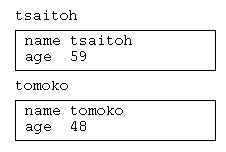
C言語では、データはポインタ型などを使わなければ、単純にメモリ上に保存される。
練習問題
科目(Subject)と学生(Student)の情報があり、科目を受講した成績(Result)で成績を管理している。
このデータを管理するためのクラスを宣言し、下に示すようなデータSubject,Result,Studentの配列を作り、下に示したような出力が得られるプログラムを作成せよ。
科目: Subject
id    name      teacher    // Subject[] subject_table = {
10010 Math      t-saitoh   //    new Subject( 10010 , "Math" , "t-saitoh" ) ,
10020 English   takaku     //    new Subject( ....
10030 Science   komatsu    // } ;

成績: Result
s_id  id         point      // Result[] result_table = {
58563 10020      83         //    new Result( 58563 , 10020 , 83 ) ,
58564 10010      95         //    new Result( ...
58573 10030      64         // } ;
58563 10010      89

学生: Student
s_id  name      age        // Student[] student_table = {
58563 tsaitoh   18          //    new Student( 58563 , "tsaitoh" , 18 ) ,
58564 tomoko    19          //    new Student( ...
58573 mitsuki   18          // } ;

以下のようなデータが出力されること
tsaitoh  18  English  takaku     83
tomoko   19  Math     t-saitoh   95
mitsuki  18  Science  komatsu    64
tsaitoh  18  Math     t-saitoh   89